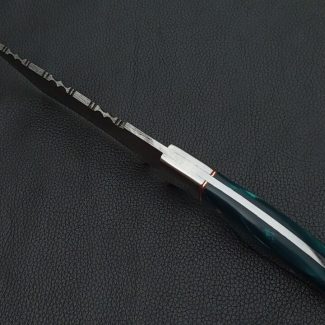
Damascus Knives — Handcrafted Damascus Steel Knives Built to Last
There’s a reason craftsmen and warriors have prized Damascus steel for over a thousand years. The layered, folded steel produces a blade unlike anything mass-produced — visually striking, edge-retaining, and surprisingly tough for everyday demands. At White Hills Knives, every Damascus knife in this collection is hand-forged using American Damascus steel, combining traditional technique with modern precision. Hence, you get a blade that performs as beautifully as it looks.
Whether you’re hunting in the backcountry, breaking down camp after a long weekend, or simply adding to a serious collection, you’ll find a Damascus steel knife here that fits how you actually use a blade.
Our Damascus Knife Collection
We carry three core styles of Damascus steel knives, each designed for a specific use. Here’s what makes each one worth considering:
Fixed Blade Damascus Knives
A fixed blade is the workhorse of the Damascus knife world. No moving parts, no pivot to wear out — just a single piece of forged steel running the full length of the handle. Our fixed blade Damascus knives are built for demanding outdoor work: field dressing game, splitting kindling, or batoning through wood on a cold morning when your hands aren’t at their steadiest.
If you’re looking for a Damascus steel hunting knife, a fixed blade is almost always the right choice. The blade geometry holds a sharp edge through tough materials, and the rigid spine gives you real control when precision matters.
Folding Damascus Knives
Our folding Damascus knives are built for people who want serious cutting performance in a format they can carry every day. The blade folds cleanly into a handle machined to hold it securely — no rattle, no slop — and opens smoothly when you need it.
Premium Damascus steel doesn’t compromise just because it folds. We source only high-quality steel for our folding knives, so the blade retains its edge and the layered pattern stays sharp and visible through years of regular use.
Pocket Damascus Knives
Compact, lightweight, and easy to clip or slip into a pocket — our Damascus pocket knives are sized for daily carry without sacrificing the quality that makes Damascus steel worth owning. These are the knives you’ll reach for dozens of times a week without thinking about it, and they’re made to handle that kind of use gracefully.
What Sets Sami Blades Damascus Steel Knives Apart
There are plenty of places to buy a Damascus knife. Here’s why ours are worth your attention:
Hand-forged, not stamped. Skilled craftsmen individually forge every blade. The layered steel pattern you see on each knife isn’t a coating or a print — it’s the result of real heat, real hammering, and real material science.
American Damascus steel. We use domestic Damascus steel because we control the quality of the materials that go into every blade. You won’t find mystery-grade alloys or inconsistent heat treatment in our knives.
Distinctive design on every knife. No two Damascus steel blades look exactly alike. The folding and layering process creates a genuinely unique signature pattern — your knife will look different from every other knife we’ve ever made.
Built for decades of use. Damascus knives aren’t disposable tools. Properly maintained, a good Damascus steel knife will outlast its first owner. Ours are made with that in mind.
Fair pricing, no inflation. Handmade Damascus knives are a premium product — but that doesn’t mean they need a premium markup. We price our knives to reflect their craft, not a brand tax.
Recommended Sharpening Angles for Damascus Steel Knives
Damascus steel responds well to sharpening, but the angle matters. Use these ranges to maintain the edge geometry your knife was designed with:
- Knife Type Recommended Angle (per side)
- Fixed Blade Knives 15–20 degrees
- Folding Knives 17–22 degrees
- Pocket Knives 18–23 degrees
How to Care for Your Damascus Steel Knife
Damascus steel is a high-carbon alloy, which means it holds an exceptional edge — but it also means it needs a little more attention than a stainless blade. Here’s what good care looks like in practice:
Clean and dry after every use. Moisture is the main enemy of a Damascus blade. Wipe it down immediately after use, especially if it’s come into contact with anything acidic, such as citrus or blood from a field-dressed animal.
Oil the blade regularly. A thin coat of mineral oil or food-safe blade oil applied every few weeks keeps the steel protected from humidity. Pay extra attention to the fuller (the groove along the flat) and near the guard, where moisture tends to collect.
Sharpen on a consistent schedule. Monthly sharpening is a good baseline for a knife in regular use. Use a whetstone or guided sharpener at the angle appropriate for your blade type (see table above).
Store it properly. Don’t leave a Damascus knife in a leather sheath long-term — leather retains moisture. A wooden block, a dry display case, or a blade roll works better for storage.
Frequently Asked Questions About Damascus Knives
Is Damascus steel still made today?
Yes, though it looks different from the ancient wootz steel it’s named after. Modern Damascus steel is made by forge-welding layers of high-carbon and low-carbon steel together, then folding and manipulating the billet to create the characteristic wave or ladder pattern. The result is a blade with excellent edge retention and a genuinely beautiful surface pattern.
How much do real Damascus knives cost?
A genuine hand-forged Damascus knife typically starts at $80–$150 for a pocket knife and can run several hundred dollars for a larger fixed-blade from a notable maker. Price depends on blade length, handle material, steel quality, and the complexity of the pattern. Budget versions under $40 are usually machine-made with etched patterns, not true Damascus.
How long do Damascus knives last?
With proper maintenance, a Damascus steel knife can genuinely last multiple generations — 50 to 100 years isn’t an exaggeration for a quality blade. The main threats are corrosion from neglect and chips from using the knife against hard surfaces it wasn’t designed for (prying, chopping bone).
How often should I sharpen a Damascus knife?
For a Damascus knife in regular use, sharpening once a month keeps the blade performing well. Between sharpenings, a few light passes on a leather strop keep the edge aligned. If you notice the knife tearing rather than slicing, that’s your signal to sharpen sooner.
What makes Damascus steel different from regular steel?
The key difference is the manufacturing process. Damascus steel is made by layering and forge-welding multiple types of steel, then working the billet through heat and hammer until those layers are compressed into a single blade. This creates the visible surface pattern and produces a blade with a combination of hard-cutting-edge steel and tougher supporting steel — characteristics difficult to replicate in a homogeneous alloy.
Are Damascus knives good for hunting?
Yes — a fixed blade Damascus steel knife is an excellent hunting knife. The blade holds a sharp edge well through tough work like field dressing, the steel is tough enough to handle real use, and the layered construction means the edge has fine microserrations that help it cut cleanly through tissue and fibrous material.
Do Damascus knives rust?
Damascus steel is typically high-carbon steel, which is more prone to rusting than stainless steel. Regular oiling and drying after use prevents rust entirely in normal conditions. If surface rust does appear, it can usually be removed with fine steel wool and re-oiling.
Ready to Find Your Damascus Knife?
Browse the full collection above. Each knife includes detailed specs, blade length, steel composition, and handle material so you can make a confident choice. If you have a question about a specific knife or need help picking the right style for how you use a blade, reach out — we know this stuff.
All orders ship with secure packaging and arrive ready to use — sharp, oiled, and in condition.