Understanding the anatomy of a sword transforms how you look at these incredible historical weapons. Whether you love history, play fantasy games, or want to start collecting, learning the parts of a sword helps you appreciate the craftsmanship behind every blade.
We will break down the basic components of a sword so you can easily understand how they work together to create a perfectly balanced tool.
The Blade: The Business End of the Sword
The blade is the most recognizable feature. It does the cutting and thrusting, but it actually consists of several distinct sections.
The Point and Edge
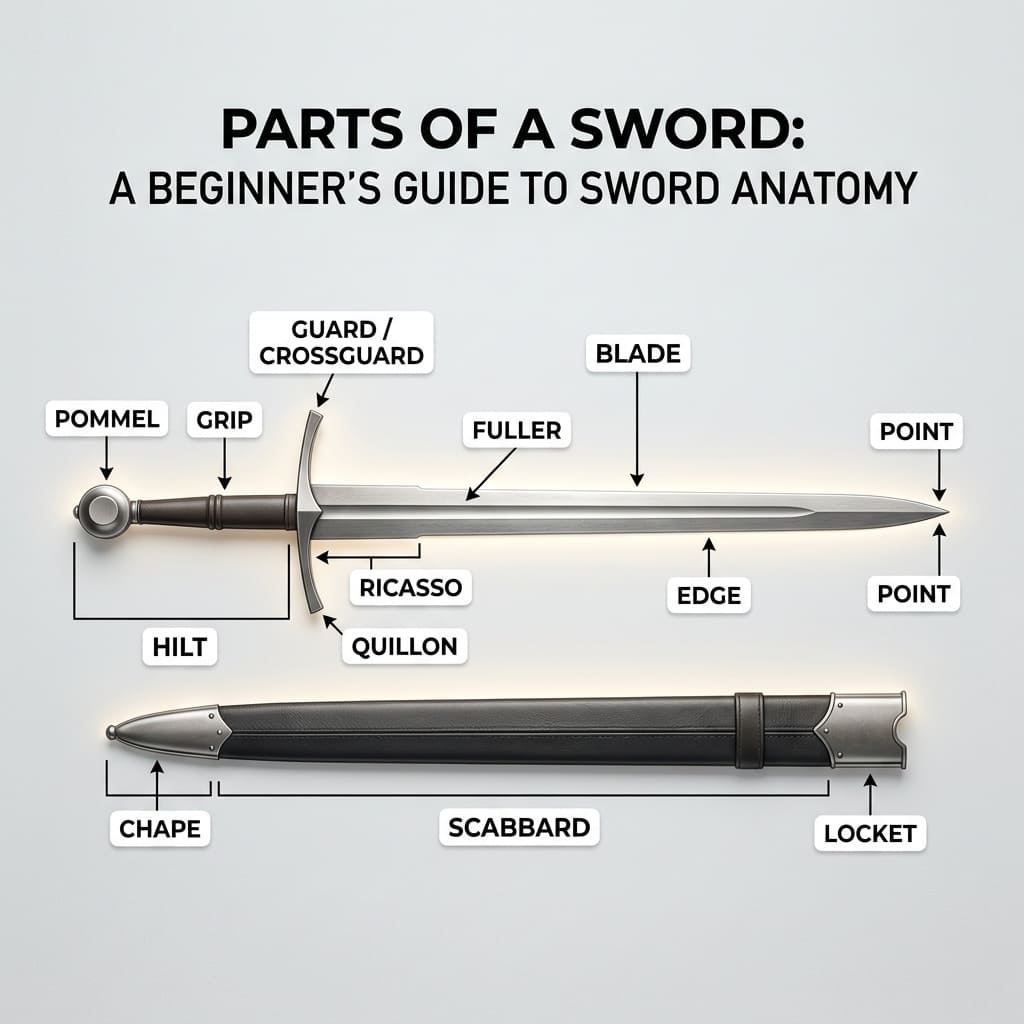
The point, or tip, sits at the very top of the blade and serves for thrusting. The edge is the sharpened side used for cutting. Some swords have a single edge, while others feature two sharp edges.
The Fuller
Many people mistakenly call this the “blood groove.” The fuller is actually a beveled groove running down the center of the blade. It lightens the sword while maintaining its structural strength, much like an I-beam used in construction.
The Ricasso
When looking at the parts of a sword ricasso, you will find an unsharpened section of the blade located just above the guard. This thick area provides extra strength to the base of the blade. On some large two-handed swords, fighters would actually grip the ricasso to gain better leverage in close combat.
The Hilt: Where Control Happens
The hilt makes up the entire handle section of the weapon. When you study the parts of a sword hilt, you will notice it contains several crucial pieces designed to protect your hand and balance the weapon.
The Guard
The guard, or crossguard, sits between the blade and the handle. Looking at the parts of a sword guard, its primary job is to stop an opponent’s blade from sliding down and hitting your hand. It also prevents your own hand from slipping up onto the sharp edge.
The Grip and Tang
The grip is exactly what it sounds like: the place where you hold the weapon. Underneath the grip lies the tang. The tang is the lower portion of the steel blade that extends down into the handle, holding the entire weapon together.
The Pommel
At the very bottom of the hilt sits the pommel. This weighted metal piece acts as a counterweight to the heavy blade. A good pommel makes a heavy sword feel light and agile in your hands. It also keeps your hand from slipping off the bottom of the grip.
The Scabbard: Protecting the Blade
A sword needs a safe place to rest when not in use. The parts of a sword scabbard generally include a throat (the opening at the top) and a chape (the metal tip at the bottom). A well-made scabbard protects the steel from rust and keeps the sharp edge from causing accidental harm.
Visualizing the Weapon
Looking at a parts of a sword diagram can make learning these terms much easier. A good diagram clearly labels how the pommel connects to the tang, and how the guard separates the blade from the grip. If you want to memorize these terms, keeping a visual guide handy is the best method.
Also Read: The Ultimate Bastard Sword Guide: History, Types, and Top Picks
Regional Variations: Japanese Swords
Swords from different cultures often use different terminology. When examining the parts of a sword Japanese style, such as a Katana, you will find unique names for the components. The guard is called a tsuba, the grip is a tsuka, and the scabbard is known as a saya. Japanese blades also feature a hamon, which is the visible temper line running along the cutting edge.
Frequently Asked Questions (FAQs)
What are the parts of a sword called?
The complete makeup of a sword is called its anatomy or morphology. The two main sections are the blade (the metal cutting portion) and the hilt (the handle assembly).
What are the five elements of a sword?
In historical forging, smiths relied on five natural elements to create a blade: earth (iron ore), fire (the forge), water (for quenching and cooling), wind (the bellows feeding the fire), and metal (the final steel product).
What are common sword terms?
The most common terms you will hear include the blade, edge, fuller, tang, pommel, crossguard, and grip.
What are five types of swords?
Five popular historical swords include the medieval longsword, the Japanese katana, the Roman gladius, the naval cutlass, and the renaissance rapier.
What is a fancy name for a sword?
People often refer to swords using poetic or historical terms like blade, broadsword, falchion, saber, or legendary names like Excalibur.
What is a hilt?
The hilt is the entire lower assembly of the sword. It includes the grip (where you hold it), the guard (which protects your hands), and the pommel (the counterweight at the bottom).
Conclusion
Knowing the parts of a sword enriches your understanding of history, martial arts, and metalworking. For enthusiasts and collectors, grasping sword anatomy is a vital skill. It allows you to accurately assess the quality, balance, and historical accuracy of a weapon. Once you know how the pommel balances the blade or how the fuller reduces weight, you will never look at these remarkable pieces of history the same way again.